A small software team can now ask an AI coding agent to inspect a repository, propose an implementation, edit files, and run checks. That changes the economics of trying an idea. It also creates a management problem: producing code becomes easier than deciding whether the code deserves to exist. For a startup, the useful question is how to shorten the path from an uncertain requirement to a dependable result.
This chapter establishes the working agreement for the series. AI can assist throughout engineering, while people remain accountable for business requirements, architecture, security, and release decisions. We will use a hypothetical service-request application for a small operations team as a running example. It is an illustration, not a claim about a delivered PNSoft or Thora Vietnam project.
Start with the work, rather than the tool
Imagine an operations coordinator who receives maintenance requests by email. Someone copies each request into a spreadsheet, assigns a technician, and later asks whether the work is finished. The visible software opportunity is a request tracker. The actual business question is whether a shared workflow reduces lost requests without creating more administrative effort.
An agent could generate a dashboard immediately. That would demonstrate interface construction, but leave important questions unanswered. Who may see a request? What happens when an assignment changes? Is an email attachment confidential? Which existing record remains authoritative? These questions shape the system more than a choice of framework does.
Begin by writing a short problem statement, naming the user, the event that starts the workflow, and the outcome that matters. Then list the assumptions that require evidence. This gives both the engineer and the agent a stable target when implementation details become distracting.
Understand three useful kinds of assistance
Explanation and investigation
AI is useful when a developer needs to understand unfamiliar code, trace a request through several modules, or compare possible causes of a failure. Ask for file references and distinguish observations from guesses. An explanation becomes trustworthy when you can follow its evidence in the repository and reproduce its reasoning with a small test.
Bounded implementation
A well-defined change gives an agent a better chance of producing something reviewable. For example, ask it to add server-side validation to an existing request form, preserve the current error format, and cover an invalid assignment. This is easier to assess than asking for an entire operations platform in one instruction.
Review and challenge
An agent can also examine a proposed change for missing cases. Ask how an unauthorized user might reach a record, what happens if a database write fails, or whether a retry creates a duplicate. Treat the resulting observations as review leads. A confident security explanation still needs an engineer to check the relevant boundary.
Keep an explicit responsibility map
Assign ownership before distributing tasks. A founder or product lead decides which user problem matters and what evidence would justify further investment. An engineer owns system boundaries, data handling, quality standards, and deployment readiness. The agent performs delegated work inside those decisions and supplies evidence that its changes meet the agreed conditions.
One person may hold several of these roles in a startup. The distinction still matters because it separates decisions that need judgment from work that can be accelerated. If nobody owns the meaning of “complete,” an agent may optimize for a successful build while the original user need remains unsolved.
Record unresolved questions alongside the task. For the request tracker, an unresolved question might be whether technicians need offline access. It should remain visible rather than quietly turning into an assumption embedded in generated code.
Give the agent enough context to work safely
A useful task brief includes the relevant workflow, existing conventions, files to inspect, and acceptance conditions. Explain any constraints on dependencies, data access, or external services. Ask the agent to identify uncertainty before making a structural change that would be expensive to undo.
For example: “Inspect the existing request creation route and form. Require an assignee from the current organization. Return the established validation response for an unknown identifier. Add a test showing that another organization's technician cannot be assigned. Keep the current URL and database schema.” This describes behavior and boundaries without prescribing every line.
Avoid pasting production credentials or customer records into a prompt. Use synthetic examples that preserve the shape of the problem. Where an agent runs commands, give it only the files, network access, and credentials required for that task. Capabilities differ across tools and configurations, so check the actual environment rather than assuming a permission model.
Build a short evidence loop
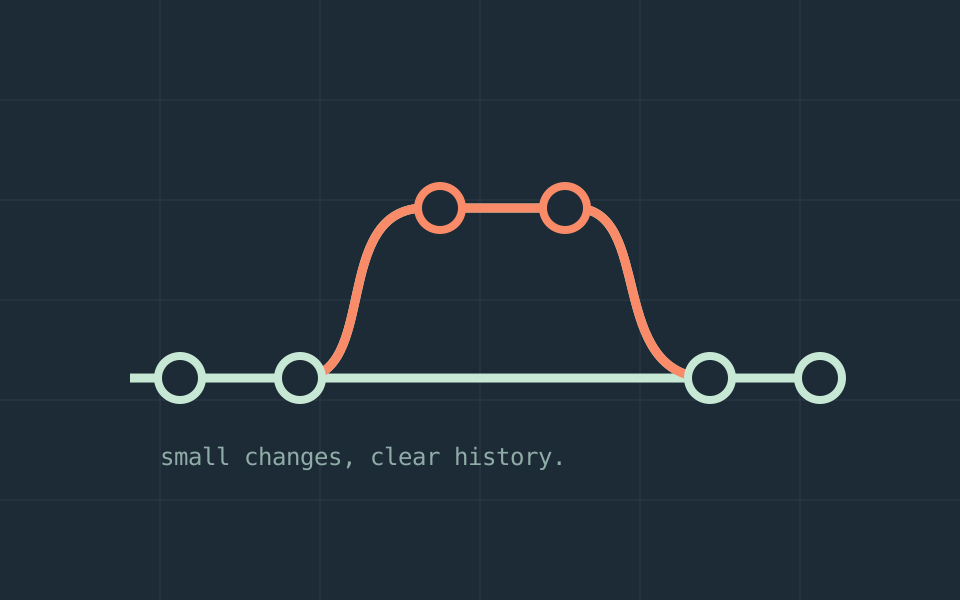
A practical loop has five steps: clarify the outcome, propose a small change, inspect the resulting diff, run meaningful checks, and examine the behavior as a user. The loop should fit around a reviewable unit of work. Making it shorter reduces the amount of incorrect interpretation that can accumulate unnoticed.
Consider request assignment. A useful check proves that an authorized coordinator can assign a technician and an unrelated user cannot. A formatting test that merely repeats the implementation provides less confidence. The evidence should correspond to a consequence the team cares about.
Keep test output and known limitations with the change. “The route test passes; email delivery was not exercised” is more useful than “everything works.” This lets the release owner distinguish verified behavior from work that still depends on an external system.
Measure the whole delivery effort
Do not judge the workflow only by how quickly code appears. Track the time spent understanding the task, reviewing changes, fixing defects, and supporting the result. A generated feature that requires repeated correction may consume more attention than a smaller manually implemented change.
For a first experiment, select a low-risk improvement with a clear acceptance condition. Record the starting problem and the review effort. After delivery, ask whether the team understood the result and could maintain it. The purpose is to learn where assistance is useful in your own environment, not to manufacture a productivity percentage.
In the hypothetical tracker, improving validation on one form is a sensible starting task. Replacing authentication and storage simultaneously would make it difficult to identify whether problems came from the tool, the specification, or the size of the change.
Establish a release boundary
A sandbox, test suite, or automated review reduces particular risks; none transfers accountability away from the team. Production access, destructive migrations, sensitive data flows, and spending commitments deserve explicit handling. Define who can authorize those actions and how the team can reverse a bad release.
Before accepting a change, an engineer should be able to explain what it does, why it fits the requirement, and what would reveal a failure. If that explanation depends entirely on an agent's summary, the review is incomplete. Reduce the change until someone can reasonably understand it.
For background, consult OpenAI's Codex security guidance and the NIST Secure Software Development Framework. These provide reference points for boundaries and engineering practice, rather than guarantees about a particular application.
Conclusion: make faster work easier to trust
AI assistance is most valuable when it makes useful engineering work faster to inspect and validate. Start with a bounded problem, retain human ownership of consequential decisions, and require evidence tied to real behavior. That foundation will matter more as tasks grow beyond a single form or function.
Before continuing, write a one-page working agreement for your team: the first task to delegate, the evidence required, the information that must remain private, and the person responsible for release. The next chapter turns a business idea into a small working slice without losing that agreement.