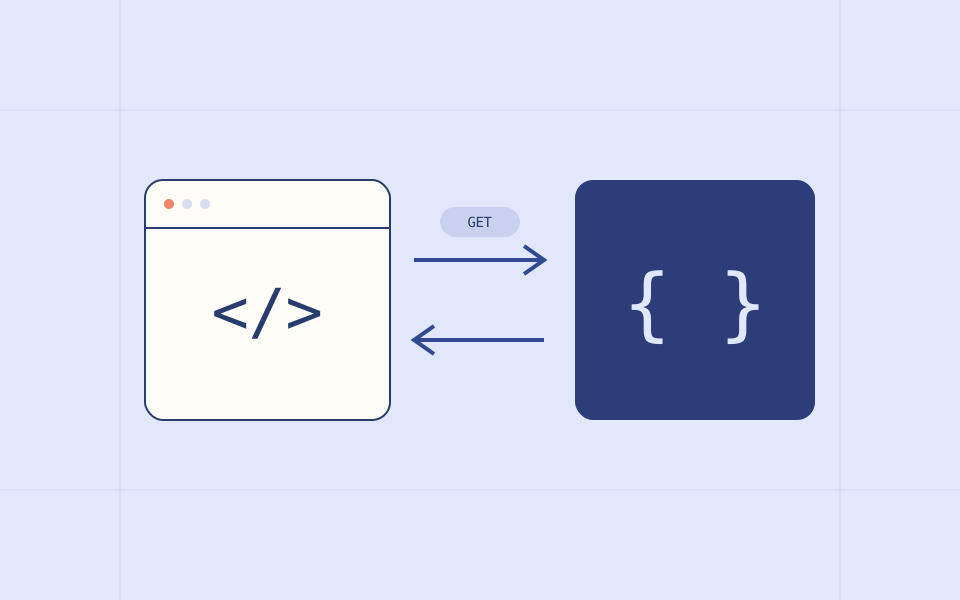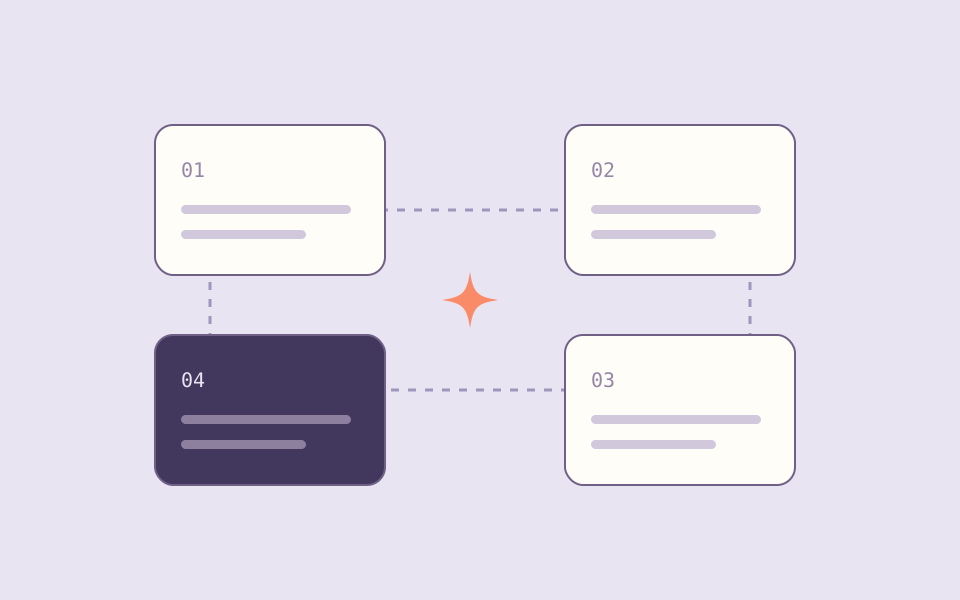
Thora Vietnam’s intended focus combines business development with AI automation, including coding and deployment. The operating model I want to establish starts with a customer problem, tests a small offer, and uses evidence to decide what to build next. This article describes that direction and its proposed working routine.
Start with the business uncertainty
A request for an AI assistant is not yet a clear business problem. Before discussing models or software, identify who performs the work, what makes it difficult, and what happens when it goes wrong. For Thora Vietnam, the first working document should connect a specific customer group to a recurring operational problem.
Write assumptions separately from facts. A proposed offer might assume that a team spends time re-entering requests between two systems. That remains an assumption until the team shows its workflow and explains the consequence.
Turn an offer into a small test
The next step is a bounded experiment: one workflow, one responsible customer contact, and an agreed output to review. A short discovery session or a supervised demonstration can test understanding before an implementation commitment. Define the information needed, access boundaries, and stopping conditions before starting.
The question is not whether AI can produce an impressive demo. It is whether the proposed change helps someone complete useful work under their actual constraints.
Connect delivery to learning
If the problem and offer justify a pilot, design and code only the smallest useful path. Keep review steps for important actions and prepare a way to undo the change. Deployment should produce something a user can try, not just a repository someone must interpret.
Record observations alongside support effort, exceptions and operating cost. A technically successful automation may still be a poor business offer if it needs constant intervention.
Make the next decision explicit
Thora Vietnam’s proposed loop ends with a decision: continue the offer, narrow the workflow, change the customer segment, or stop. Keep a short record of the assumption, evidence and reason. Completed tasks are useful, but learning that changes the next commitment is the point of the loop.
Define the first business model as a hypothesis
A useful starting offer for Thora Vietnam to test is a workflow discovery session followed, when justified, by a separately scoped AI automation pilot. The intended buyer, acquisition channel, price and support arrangement are assumptions to investigate. Keep a one-page model covering the customer, the work they need done, the offer, delivery effort, partners and revenue. A completed model is a map of questions, not evidence of a viable business.
For example, investigating how a small service team handles incoming enquiries is a possible experiment. It is not a claim that Thora Vietnam already serves that segment. Avoid offering a general AI platform before a particular workflow and buyer are understood.
Choose a stage by evidence, not the calendar
The immediate application is a baseline and discovery exercise: inventory available skills and delivery capacity, choose one workflow to investigate and record what is still unknown. The next stage is a bounded pilot only if a customer confirms the problem and agrees to the test. Later implementation means making a repeatedly useful service easier to deliver, not expanding a demo into a product by default.
- Explore: observe the workflow and identify a responsible buyer, user and decision-maker.
- Test: agree one outcome, a spending limit, a review date and a manual fallback.
- Repeat: look for repeat use, a sustainable commercial arrangement and manageable support effort.
- Expand: consider reusable components or a product only when repeated delivery gives a reason.
Use an experiment brief before committing delivery time
The brief below is a starting template for future work. Its limits must be agreed for each experiment; the blanks are not targets already achieved by Thora Vietnam.
Customer group and workflow:
Problem observed and source of evidence:
Assumption most likely to invalidate the offer:
Smallest test and what we will not build:
Owner, review date and time/spending limit:
Evidence that supports or contradicts the assumption:
Decision: continue / change / stop
Next commitment and reason:
Keep the future roadmap conditional
The first implementation goal is a traceable decision, even when the decision is to stop. If a pilot helps but delivery remains heavily customized, Thora Vietnam can continue as a focused service while improving its operating process. If several unrelated customers need the same outcome and accept a similar scope, a reusable service package becomes a hypothesis worth testing. Hiring, subscriptions and product development should each address a demonstrated constraint, with their own limits and review points.
This is a proposed operating direction for Thora Vietnam. No customer contracts, revenue, pilot results or product-market fit are being asserted. Update the guide with dated observations when the work actually takes place.
Further reading
Background for the method; the Thora Vietnam workflow above is a proposed application.
The Lean Startup — Methodology
Strategyzer — Business Model Canvas